
Bushra's newest work published in Neuron!
Bushra’s newest work on the “Emergence of neuronal diversity during vertebrate brain development” has been published in Neuron . As part of this work Bushra and coauthors cataloged ∼220,000 zebrafish brain cells encompassing 12 stages from embryo to larva to establish a zebrafish brain development atlas. They segment these cells into ∼800 clusters with both known and novel gene markers and provide an overview of the diversification of neurons and progenitors across these time points.
To find out more read the paper here!
Congratulations to Max and Annika on being awarded a SNSF Spark grant!
The aim of Swiss National Science Foundation Spark Grant is the rapid funding of projects that show unconventional thinking and introduce a unique approach. Max and Annika will be investigating behaviour and ecology in Lake Tanganyikan cichlids in collaboration with Walter Salzburger’s group at the Zoological Institute at the University of Basel.
To find out more about spark click here
To find out more about the Salzburger lab and their work on cichlid speciation click here
Photo credit: Maxwell Shafer
Congratulations to Oded on his award of a EMBO Long Term Fellowship!
Oded has been awarded highly competitive EMBO Long Term Fellowship, congratulations!
Jakob becomes a Boehringer Ingelheim Fonds Fellow
Congratulations to Jakob on being awarded a prestigious BIF PhD fellowship! We look forward to seeing your project grow
Congratulations to Emily on her fellowship!
Emily is now a fellow of the Jane Coffin Childs Memorial Fund for Medical Research, congratulations Emily!
Alex Schier elected to the National Academy of Sciences
Congratulations Alex on being elected to the American National Academy of Sciences, a huge achievement reflecting the huge impact Alex has had on our understanding of logic governing cellular differentiation .
Read more about it here: https://www.biozentrum.unibas.ch/news-events/news/details/silvia-arber-and-alex-schier-elected-to-the-national-academy-of-sciences/
Alex awarded George Streisinger Award
The International Zebrafish Society (IZFS) established the George Streisinger Award to honor Dr. Streisinger's outstanding contribution to the field. This award recognizes sustained and foundational work within the zebrafish field that has had wide benefit to our field.
Congratulations Alex!
To learn more follow this link: https://www.izfs.org/awards/george-streisinger-award
Alex publishes review on single-cell multimodal omics
Single-cell RNA sequencing (scRNA-seq) has revolutionized many fields by allowing high-throughput analysis of cell transcriptomes at an individual level. In a newly published review Alex writes about how scRNA-seq has been paired with other methods to obtain more complete knowledge of the genotypes and phenotypes of cells.
Read more here: Single-cell Biology: Beyond the Sum of Its Parts
New bioRxiv paper on Nodal morphogen signaling gradients
Congratulations to Nate and Adam as their new paper is up on the BioRxiv!
How morphogen signaling gradients are established is incompletely explained yet crucial for our understanding of how organisms develop into precisely formed animals. Nate and Adam have investigated the role of Nodal co-receptor Oep and find that it is important for generating correct Nodal signaling patterns by restricting ligand spread and sensitizing cells. Read more here:
The pattern of Nodal morphogen signaling is shaped by co-receptor expression
Bushra's new paper on the emergence of neuronal diversity is now on the bioRxiv!
Congratulations to Bushra on her new paper: Emergence of neuronal diversity during vertebrate brain development
Here she describes the developmental trajectory of >200,000 brain cells in 12 stages from 12 hours post-fertilization to 15 days post-fertilization. She finds stage and tissue specific neurogenic regulatory paradigms.
Madalena awarded a prestigious EMBO Long-term Fellowship
Congratulations Madalena on being awarded this highly competitive fellowship! Well deserved!
Schier lab settles into the Basel Biozentrum
The Schier lab has increased its Basel numbers in the last couple of months! We’re very happy to welcome a few new faces to the lab including:
Postdocs: Madalena (Portugal), Oded (Israel) and Lucia (New Zealand)
PhD student Jakob (Germany)
Administrator: Alexandra (Germany)
A warm belated welcome to you all!
Shristi defends her Graduate Thesis!
A big congratulations to Shristi who defended her thesis on Friday the 11th of October! Shristi has made major contributions to the understanding of the cellular identities of Habenula neurons. Fantastic work Shristi!
Jess leaves for Grad School in Sunny California
Jess will be starting a new adventure as a Graduate Student at UC Berkeley.
Congratulations Jess and all the best for your future!
Martin's paper on Temperature Representations was published in Neuron!

Martin’s paper “Convergent Temperature Representations in Artificial and Biological Neural Networks” was published in Neuron!
Owen's paper on dark flash habituation published in Current Biology

Owen Randlett, also a postdoc in the Engert and Granato labs, has published his paper “Distributed Plasticity Drives Visual Habituation Learning in Larval Zebrafish” in Current Biology.
Alex is awarded an European Research Council Advanced Grant

Summer's paper published in Cell
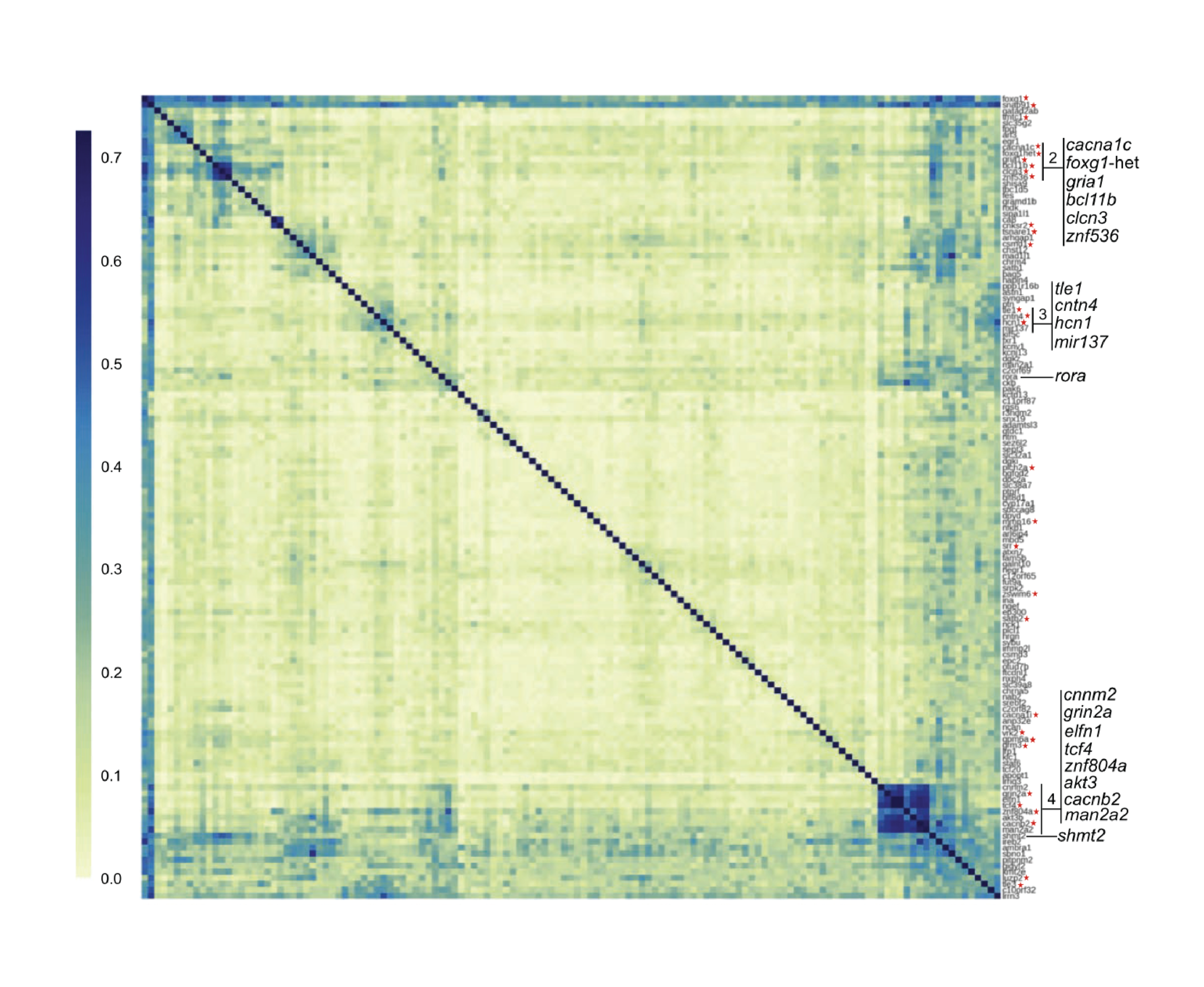
Our latest publication “Phenotypic landscape of schizophrenia-associated genes defines candidates and their shared functions”, was published in Cell.
Mehdi's paper published in eLIFE!
Our lab has published in eLIFE a study on long non-coding RNAs: “Individual long non-coding RNAs have no overt functions in zebrafish embryogenesis, viability and fertility”.
The functions of long-coding RNAs (lncRNAs) remain a mystery. In this study 25 zebrafish lncRNAs candidate genes were selected based on their conservation, expression pattern and proximity to developmental regulators. CRISPR-Cas9 was used to generate a total of 32 deletion alleles across these 25 lncRNAs. They found that none of these genes are required for embryogenesis, viability or fertility. This study suggests that lncRNAs don’t have obvious roles in embryogenesis, viability or fertility indicating they may have more redundant, subtle or context dependent roles.
Congratulations to lead author Mehdi, as well as Kathryn and Lindsey!